


Two weeks ago I wrote that Malaysia is not Indonesia — that regional brands keep running the Indonesia playbook against Malaysia with the currency changed, and leaving money on the table doing it.
A reader wrote back with the obvious question. Fine. So what does the Indonesia playbook actually look like?
Fair. I spent a whole issue telling you what Indonesia is not the right template for. I owe you the other side of it.
So here’s a different brief, from a different client. This one runs a mid-sized local snack and beverage brand out of Kuala Lumpur. Good business — profitable in Malaysia, decent in Singapore, just cracked the Philippines. He’d been staring at the map and decided Indonesia was next. Of course it was. Ten times the population, the biggest ecommerce market in the region, right next door, similar language. “It’s basically a bigger Malaysia,” he told me. “We’ve already proven the model. We just scale it across the Strait.”
I asked him how he planned to handle the islands. Long pause. “What do you mean, the islands?” That’s the whole issue, right there. He was about to make the exact mistake I’d just warned the Jakarta brands about — only in reverse. He’d taken a playbook that works in a compact, urban, three-platform, English-tolerant peninsula and assumed it would scale into a 280- million-person archipelago of 17,000 islands, where the second-largest sales channel is a live video stream and half the growth is happening in cities he couldn’t name.
Indonesia isn’t a bigger Malaysia. It isn’t a bigger anything. It’s the market that makes its own rules — literally, it has banned business models that work everywhere else — and it punishes brands that arrive with a borrowed map.
This is what the Indonesian map actually looks like.

The Setup: the gravitational centre of Southeast Asian commerce
Let’s start with scale, because scale changes the physics of everything that follows.
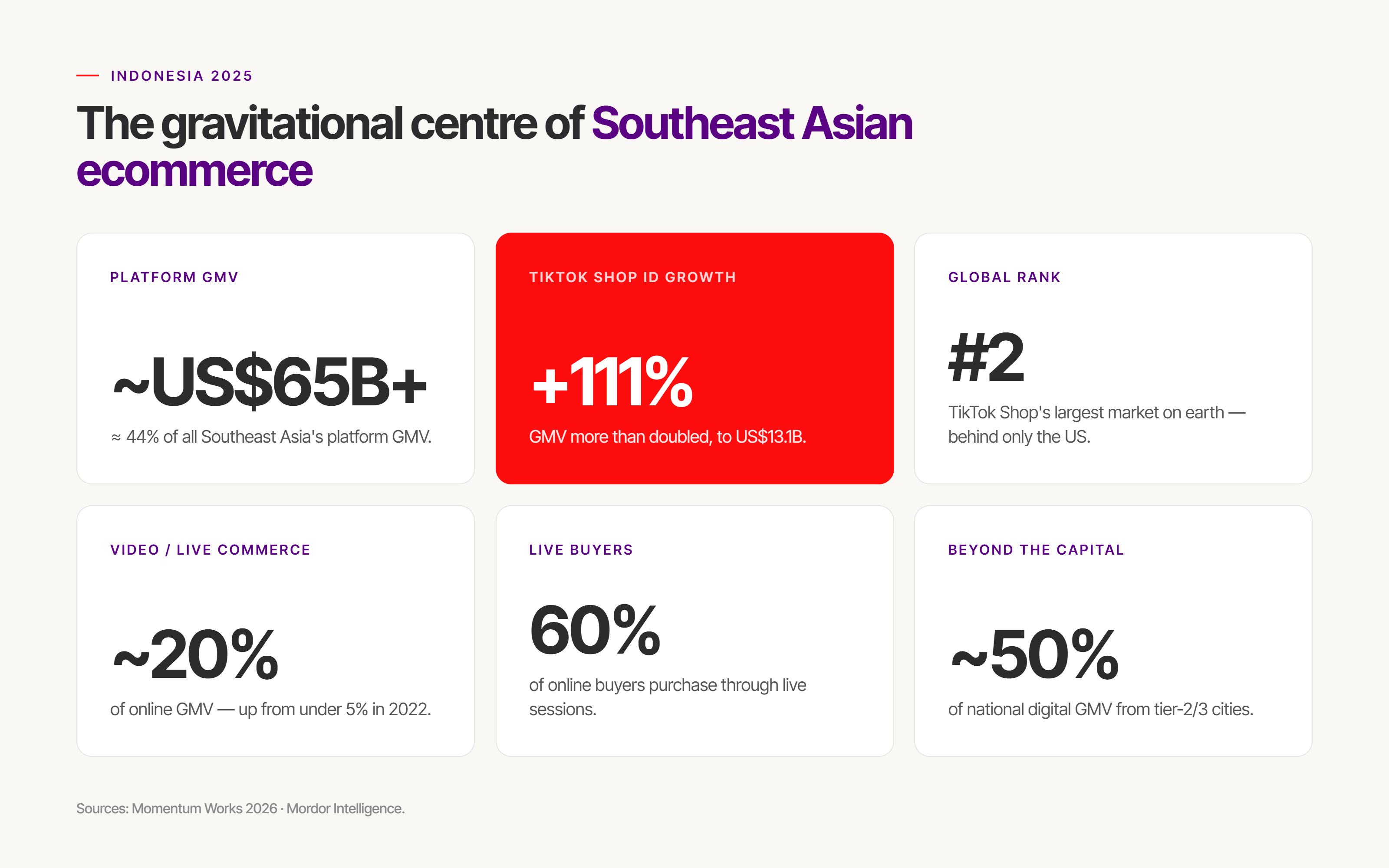
Southeast Asia’s platform ecommerce hit US$157.6 billion in GMV in 2025, up +23% year-on-year and nearly triple what it was in 2020 (Momentum Works, Ecommerce in Southeast Asia 2026). Indonesia alone is roughly 44% of that — call it a US$65 billion-plus platform market sitting inside one country. It is not the biggest market in the region by a nose. It is the biggest by a landslide, several times the size of Malaysia and larger than the next two or three SEA markets combined.
Here’s what that market looked like through 2025:
~US$65B+ in platform GMV — about 44% of all of Southeast Asia (Momentum Works, 2026)
TikTok Shop Indonesia drove US$13.1 billion in GMV, up +111% year-on-year — making Indonesia TikTok Shop’s second-largest market on earth, behind only the United States (Momentum Works, 2026)
Shopee holds roughly 52% of the Indonesian market; the Shop | Tokopedia combine sits around 35%; Lazada has slipped to single-to-low-double digits (industry estimates, 2025)
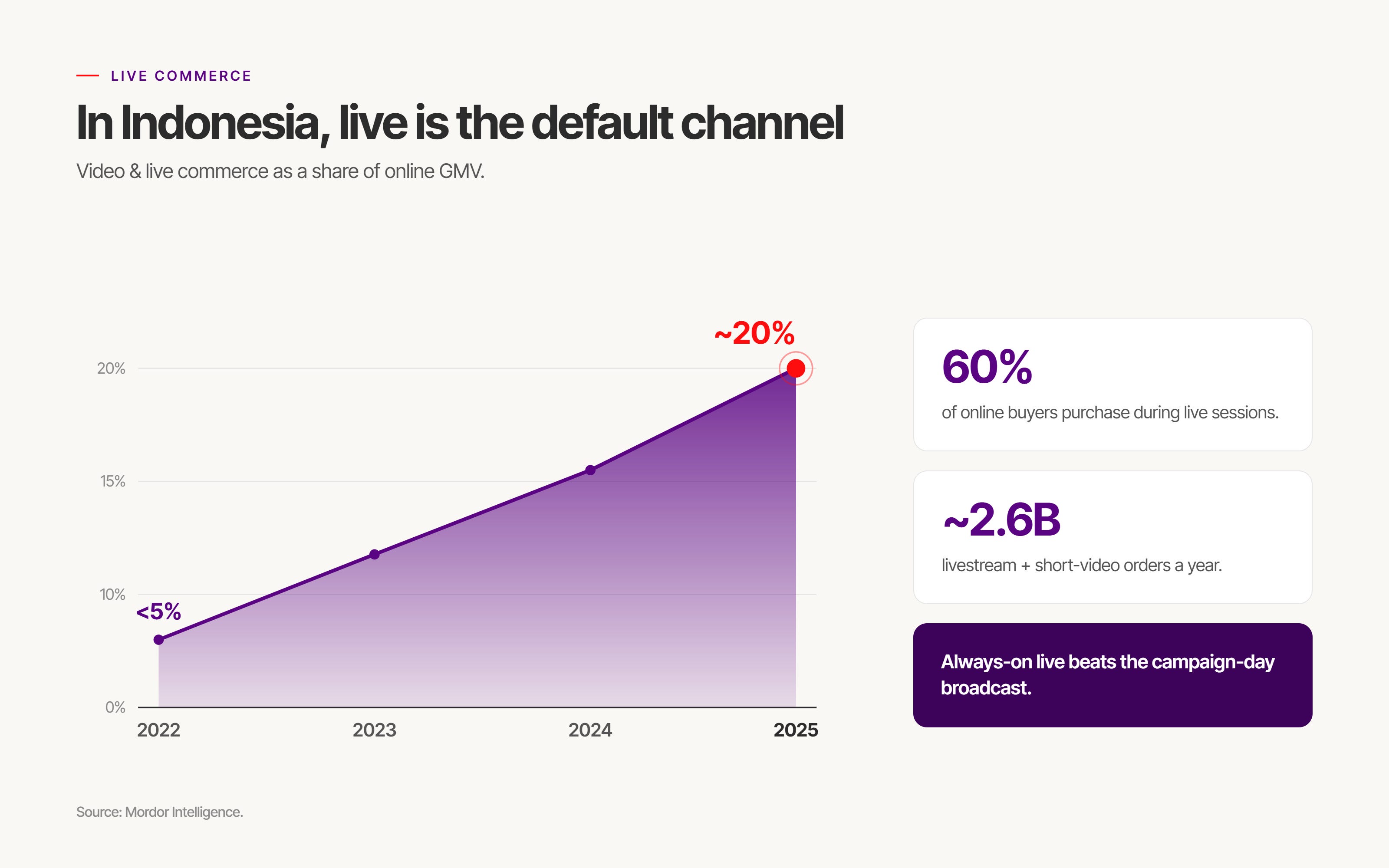
Video commerce reached ~20% of online GMV in 2025, up from under 5% in 2022, and 60% of online buyers now purchase through live sessions — an estimated 2.6 billion livestream and short-video orders in a single year (Mordor Intelligence)
Tier-2 and tier-3 cities are on track to generate half of national digital GMV, up from around 40% in 2021 (Mordor Intelligence)
None of that says “scale up your Malaysia plan.” It says you are walking into the single largest, most concentrated, most livestream-native, most geographically dispersed ecommerce market in the hemisphere — one that has already deported a US$1.5 billion business model for breaking its rules.
Because here is the thing that makes Indonesia genuinely different, and not just bigger: in late 2023, Indonesia banned social media platforms from processing sales. TikTok Shop — at the time the fastest-growing channel in the country — went dark overnight. It only came back by buying 75% of Tokopedia for US$1.5 billion and folding its commerce operation inside an Indonesian company. No other market in Southeast Asia has done anything like that.
So when I say Indonesia is its own beast, I mean it structurally. It has its own scale, its own rules, its own geography, its own dominant channel, and its own winners. Get those five forces right and it’s the prize of the region. Get them wrong — arrive with the bigger-Malaysia map — and you’ll spend a fortune learning each one the hard way.
The Five Forces of the Archipelago
This is the framework. Five forces that make Indonesia structurally unlike Malaysia, Singapore, or anywhere else you’ve won — and what each one changes about how you operate.
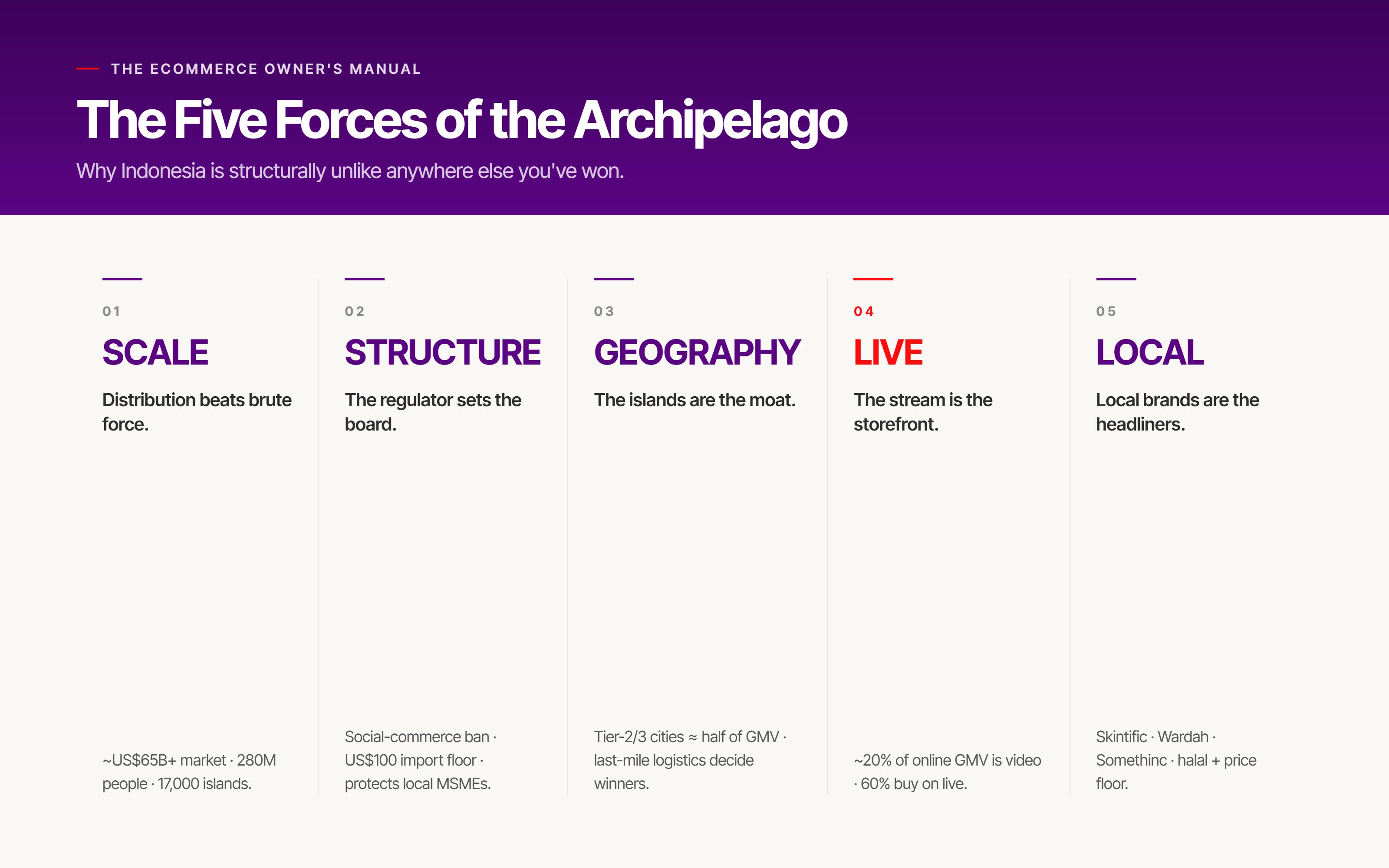
Force 1: Scale changes the physics — distribution beats brute force
Most operators read “biggest market in the region” as “biggest version of what I already do.” Spend more, run more campaigns, scale the engine. That instinct is exactly wrong, and Indonesia’s scale is the reason.
In a compact market like Malaysia or Singapore, you can win with concentrated spend and tight operation — the country is small enough that brute-force marketing reaches most of it. Indonesia is the opposite shape. It’s a 280-million-person country spread across 17,000 islands and dozens of distinct regional markets. There is no single “Indonesian consumer” to brute-force. Jakarta is not Indonesia any more than KL is Malaysia — except the gap between the capital and the rest is far wider, and the rest is far bigger.
The lever that wins Indonesia isn’t spend intensity. It’s distribution depth — how many of those regional markets you can actually reach, stock, ship to, and convert. A brand that pours its whole budget into a slick Jakarta-and-Java campaign is fishing in maybe half the pond. The growth — the part that’s compounding fastest — is in the other half, in cities most regional planners can’t place on a map.
The implication: in Indonesia, your constraint is reach, not budget. Plan around how far your distribution and content travel across the archipelago, not how loud you can be in the capital.
Force 2: The regulator sets the board — and it’s playing for the home team
Indonesia is the only Southeast Asian market where the government has actively redrawn the commerce map, and it did so to protect domestic sellers. You cannot operate here without understanding the rules of the board, because they are not the same rules as anywhere else.
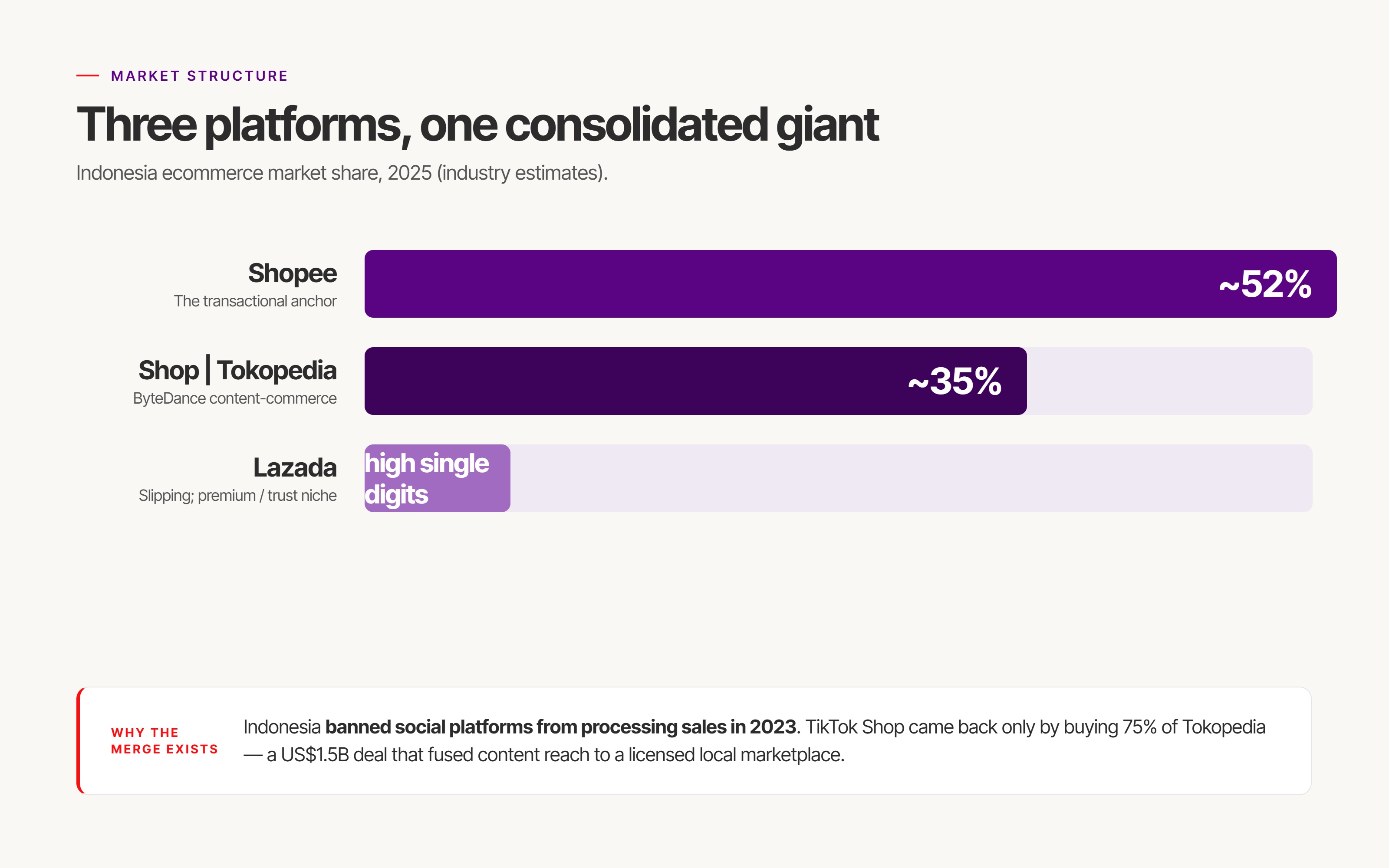
The headline event: Trade Regulation No. 31 of 2023, effective 26 September 2023. Two pieces matter most.
First, it banned social commerce platforms from processing transactions — they can host content and promotion, but not the checkout. This is what killed TikTok Shop overnight in late 2023 and forced the US$1.5 billion Tokopedia acquisition to bring it back inside an Indonesian entity. The integration concluded in April 2025. The lesson isn’t trivia — it’s that the channel structure you’re planning around in Indonesia exists because of a regulatory workaround, and it could move again.
Second, it set a US$100 minimum price floor on imported goods sold directly cross-border (with a permitted-goods exception list). Translation: you cannot dropship cheap imported product into Indonesia the way you might cross-border into other SEA markets. Jakarta has also repeatedly slow-walked or blocked the ultra-cheap cross-border players that have flooded other markets. The explicit, stated objective is to protect domestic MSMEs — local sellers — from foreign competition.
Read those two moves together and the strategy writes itself: Indonesia rewards brands that localise and punishes brands that import. Local stock, local entity, local sellers, local content. The regulator has put its thumb firmly on the home team’s side of the scale.
The implication: plan for a local operating footprint — local fulfilment, a compliant selling structure, and a content engine that runs inside the platforms rather than around them. Cross-border-only, import-light strategies that work elsewhere hit a regulatory wall here.
Force 3: Geography is the moat — the fulfilment network, the tier-2/3 surge and the payment methods
This is the force my snack-brand Ecommerce client had never thought about, and it’s the one that separates the brands that scale in Indonesia from the ones that stall at the Jakarta city limits.
Indonesia’s growth is decentralising fast. Tier-2 and tier-3 cities are on track to produce half of national digital GMV, up from about 40% in 2021 (Mordor Intelligence). Jakarta, Surabaya, and Bandung still lead, but the momentum is in Medan, Makassar, Yogyakarta, and a long tail of provincial capitals where households are coming online and getting banked for the first time. That’s where the next decade of growth lives — and it’s the part a Jakarta-office plan systematically under-serves.
Serving it is a logistics problem before it’s a marketing problem. The archipelago is the hardest last-mile geography in Southeast Asia, and the brands winning it are the ones plugged into the dense local courier network — J&T, JNE, SiCepat, Ninja Xpress, Pos Indonesia — and the micro-fulfilment hubs pushing stock closer to provincial consumers. That hub network has been cutting shipping costs 12–18% and unlocking next-day delivery beyond Java, helped along by roughly IDR 400 trillion (US$25.8 billion) in government infrastructure spend (Mordor Intelligence).
And then there’s how those consumers pay. Indonesia is not a card market. The payment mix runs digital wallets (~35% — GoPay, OVO, DANA, ShopeePay), bank transfer (~26%), then a long tail including BNPL and cash-on-delivery at ~8% (industry data, 2025). COD share is falling as QRIS and wallets spread — QRIS transaction volume jumped 175% year-on-year in 2024 — but in the tier-2/3 and rural markets that are driving growth, COD is still how a meaningful slice of first-time online buyers transact. And COD carries a tax: it correlates with materially higher return and refusal rates, which lands straight on your unit economics.
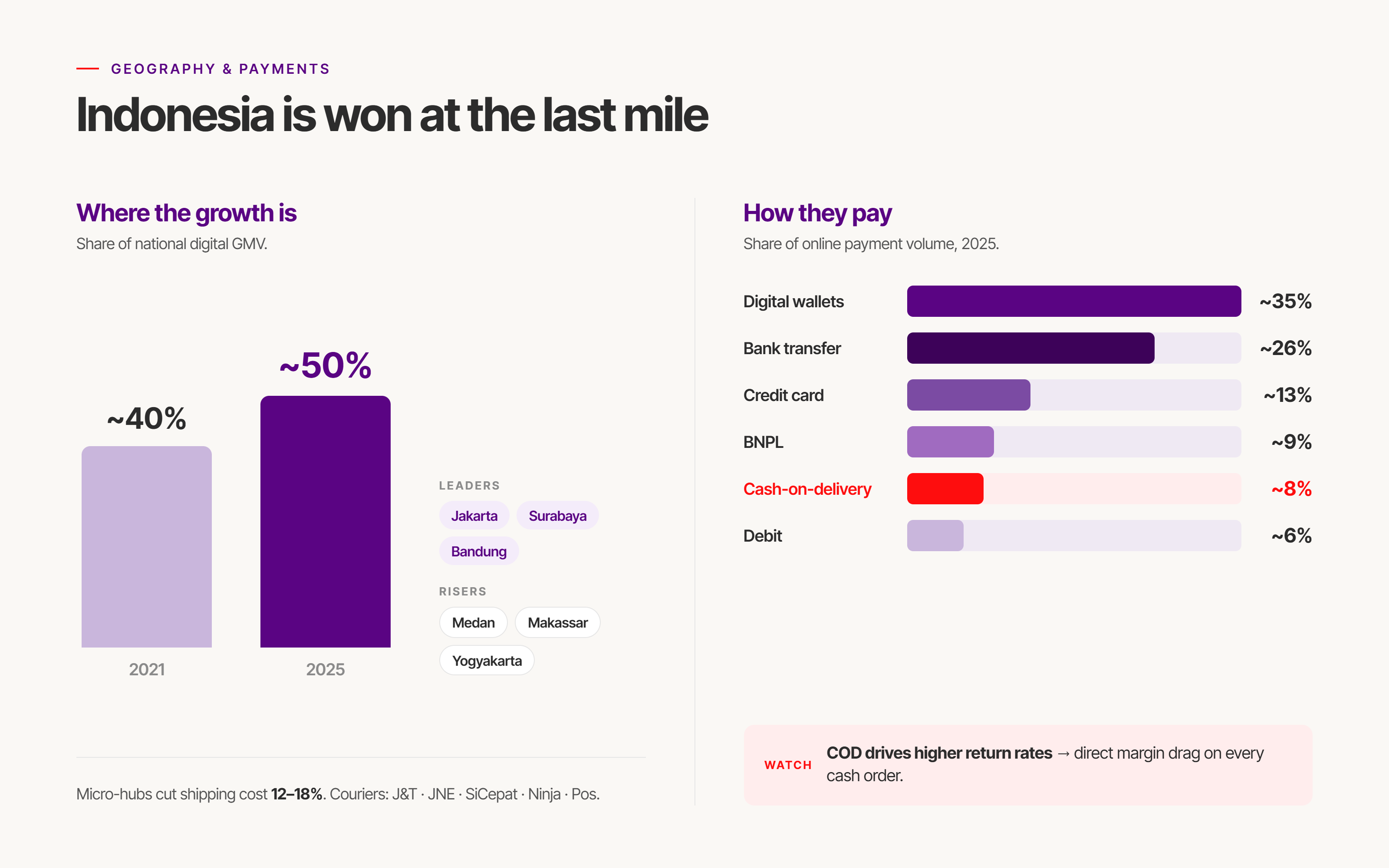
The implication: Indonesia is won at the last mile, not the campaign. Pick your logistics partners deliberately, push stock into regional hubs, plan for COD’s return-rate drag in your margins, and treat tier-2/3 reach as a primary growth strategy — not an afterthought once Java is “done.”
Force 4: Live is the default channel, not a tactic
In most markets, livestream is a thing you add. In Indonesia, livestream is increasingly the thing itself.
Video commerce reached around 20% of all online GMV in 2025 — up from under 5% three years earlier — and 60% of online buyers now say they purchase through live sessions, totalling an estimated 2.6 billion livestream and short-video orders in a year (Mordor Intelligence). Indonesia is the most live-commerce-native large market on the planet. The TikTok-Tokopedia machine is built around exactly this: short-video discovery and live checkout fused into one funnel, now embedded into Tokopedia’s catalogue post-integration.
This is a different operating model, not a content add-on. Winning it means always-on live — not a campaign-day broadcast, but daily or near-daily streaming, often for hours, run by hosts who know how to demo, bundle, handle comments, and close in real time. It means an affiliate and creator army at the nano and micro tier, sized for a country of 280 million, not the tight creator roster you’d run in Malaysia. It means production capacity — studios, hosts, scripts, offers — as a core operational function, not something you outsource per campaign.
A brand that ports its Malaysia content plan into Indonesia — polished static creative, a handful of mid-tier creators, the occasional live event — is bringing a campaign to a channel war. The Indonesian buyer is sitting in a live session waiting to be sold to. If you’re not in the room, your local competitor is.
The implication: build live commerce as core infrastructure — daily streaming, a deep creator/affiliate base, in-house or dedicated production. In Indonesia, the live stream isn’t a campaign tactic. It’s the storefront.
Force 5: Local wins — domestic brands, halal trust, and the price floor
The last force is the one imported brands find hardest to accept: in Indonesia, the local champions are not the warm-up act. They’re the headliners.
Look at beauty, the most active and most-watched category on TikTok Shop Indonesia (beauty and personal care is around 14% of online retail). The brands winning it are largely Indonesian — Skintific, Wardah, Somethinc — not imported Western or Korean labels. Skintific in particular has run the exact playbook this whole issue is describing: aggressive pricing (hero products at US$8–15 where international equivalents sit at US$25–35), a creator-led discovery engine, and live commerce as the spine. Local brands win because they understand the price psychology, the cultural register, and the trust signals — and because the regulator, as we saw, is actively tilting the board toward them.
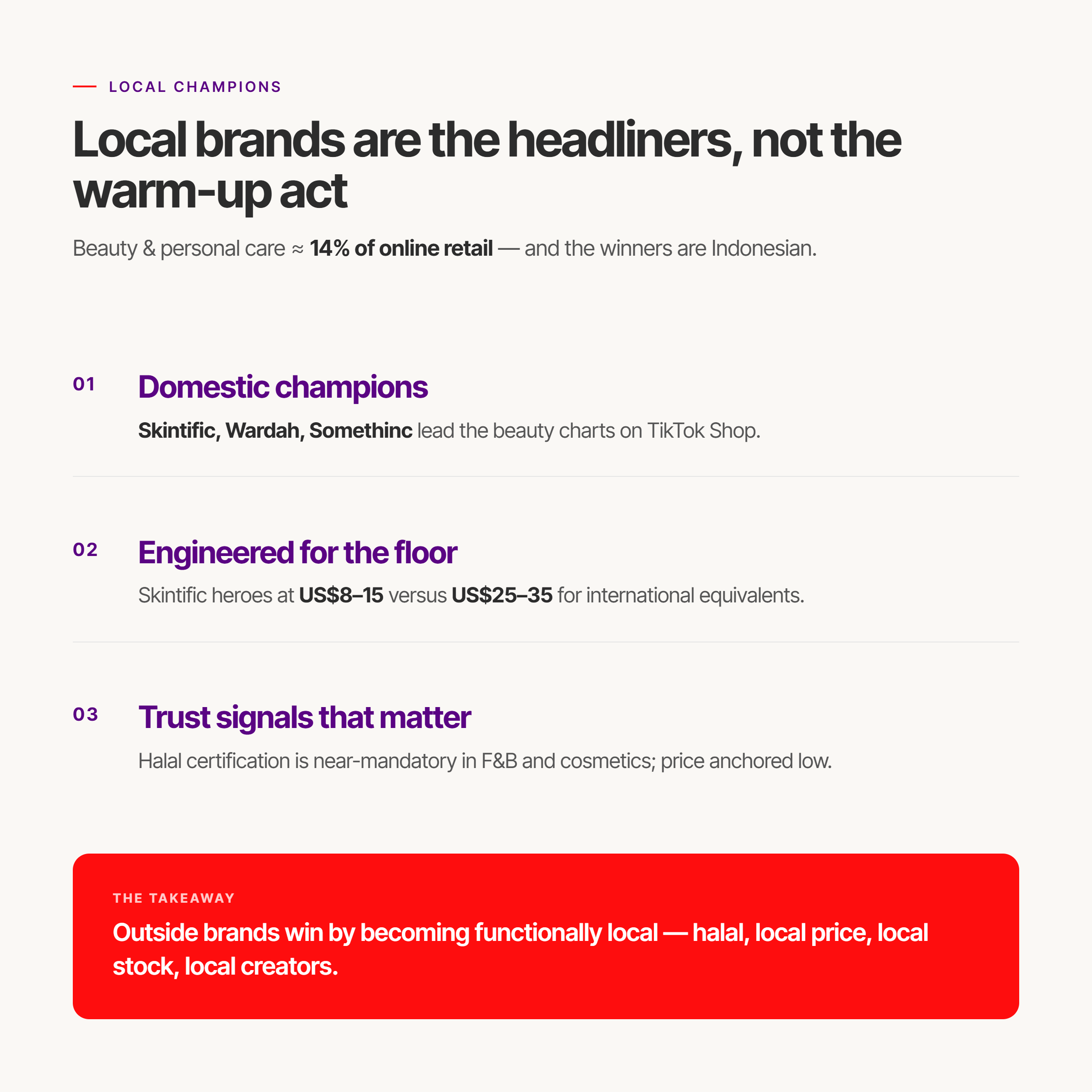
Two trust signals matter more in Indonesia than almost anywhere else in the region. Halal certification is close to non-negotiable in food, beverage, and cosmetics — it’s a baseline trust factor, not a niche feature. And price runs to a floor: the Indonesian value-tier consumer anchors low, and a price ladder built for Malaysian or Singaporean wallets will read as expensive and foreign. You’re often competing against a domestic brand that has engineered its cost base specifically for that floor.
This doesn’t mean an outside brand can’t win. It means an outside brand has to stop behaving like an import. Local manufacturing or co-packing, halal certification, locally engineered price points, a local creator base, content made by people who are visibly from there. The brands that treat Indonesia as a place to sell into lose to the brands that treat it as a place to be from.
The implication: localise to the point of being indistinguishable from a domestic brand where it counts — halal, price floor, local content, local stock. In Indonesia, “imported” is not a premium signal. It’s a handicap.
The Diagnostic: are you running Indonesia like a bigger Malaysia?
Six signs your Indonesia plan is a scaled-up peninsula plan. Be honest.
🔴 Sign 1: Your Indonesia plan is your Malaysia plan with a bigger budget. Same structure, same channel mix, same content model — just more spend. You didn’t build an Indonesia plan. You inflated one.
🔴 Sign 2: You can’t name your tier-2/3 city strategy. If your growth plan is “win Jakarta and Java, then see,” you’re planning around half the market and ignoring the faster-growing half.
🔴 Sign 3: Livestream is a line item, not the spine. A few creators and a campaign-day broadcast, in a market where 60% of buyers purchase on live and video is 20% of GMV. You brought a campaign to a channel war.
🔴 Sign 4: You’re planning cross-border, import-light. If the plan leans on dropshipping cheap imported stock without a local footprint, you’re on the wrong side of the US$100 floor and the regulator’s MSME agenda.
🔴 Sign 5: No halal, no local price floor, no local content. You’re bringing a Malaysian or Western price ladder and English-ish creative into a market where the local champions have engineered for the floor and certified for trust.
🔴 Sign 6: You’re running it from a Jakarta (or KL) desk with no last-mile plan. No deliberate courier strategy, no regional hubs, no plan for COD return rates. The hardest last-mile geography in SEA, run as an afterthought.
Three or more? You’re running Indonesia on the bigger-Malaysia map. The fix isn’t a bigger budget. It’s a plan built from the Indonesian seat — archipelago-first, live-first, local-first.
Two From the Field
Both anonymised — composites drawn from work in and around the Indonesian market, not named clients.
The imported beauty brand that stopped being an import
A regional beauty brand — real product, genuine following in its home market — pushed into Indonesia the way most do: shipped stock cross-border, ran its existing creative with Bahasa subtitles, lined up a handful of mid-tier creators, and waited. It didn’t fail outright. It just sat there, quietly outsold by local brands it had never heard of, on a channel (live) it was barely using, at a price point that read as expensive next to the domestic shelf.
The turnaround was structural, not cosmetic. The brand moved to local co-packing and got its hero range halal-certified — clearing the trust bar. It re-engineered the price ladder down to the Indonesian floor instead of converting its home-market prices across. And it rebuilt the content engine around always-on live commerce and a broad nano/micro creator base sized for the market — not a tight roster, an army. Same products, same brand. A completely different operating model — built to look domestic, not imported.
The lesson for the reader: in Indonesia, the imported-brand instinct — ship in, translate, sprinkle creators — is the losing move. The winning move is to become functionally local: local stock, local certification, local price, local live.
The Java-only brand that found the other half of the market
A brand doing well across Jakarta, Surabaya, and Bandung had quietly concluded that was the Indonesian market. Growth had flattened, and the read was “we’ve saturated.” They hadn’t saturated. They’d hit the edge of the geography they’d bothered to serve.
The unlock was distribution and last-mile, not marketing. They plugged into the regional courier and micro-hub network to push stock closer to provincial consumers, brought delivery times and costs down beyond Java, and built for COD properly — pricing in the higher return rates instead of being surprised by them. Then they briefed regional creators who actually spoke to tier-2/3 audiences, rather than recycling Jakarta content nationally. The “saturated” brand found a second growth engine in the cities it had been treating as rounding errors.
The lesson: in Indonesia, flat growth often isn’t saturation — it’s the edge of your distribution. The next half of the market is real, it’s growing faster than the first half, and it’s a logistics problem before it’s a demand problem.
The Market-Entry Checklist
If you’re planning Indonesia — or fixing an Indonesia plan that’s quietly stalling — here’s the Monday-morning version.
1. Plan for distribution depth, not spend intensity. Map the regional markets you can actually reach and stock, and treat that reach as your primary growth constraint. Indonesia is won by how far you travel, not how loud you are in Jakarta.
2. Build a local operating footprint. Local fulfilment, a compliant selling structure, local stock. Assume the regulator favours the home team — because Trade Regulation 31/2023 explicitly does — and get on the right side of the US$100 import floor.
3. Win the last mile. Choose your couriers deliberately — J&T, JNE, SiCepat, Ninja, Pos — push inventory into regional micro-hubs, and price COD’s return-rate drag into your margins from day one.
4. Make tier-2/3 a primary strategy. Half the GMV and the faster-growing half. Brief regional creators, tailor content beyond Jakarta, and serve the provincial cities as a core market — not a phase two.
5. Build live commerce as infrastructure. Always-on streaming, a deep nano/micro creator and affiliate base sized for 280 million people, dedicated production capacity. In Indonesia the live stream is the storefront, not a campaign.
6. Localise until you stop looking imported. Halal certification where it counts, a price ladder engineered to the Indonesian floor, content made by people visibly from there, local manufacturing or co-packing where the economics allow. Be from there, don’t sell into there.
The Close
My snack-brand client went quiet when I asked about the islands — and that pause was the most useful thing that happened in the whole conversation. It was the moment “it’s basically a bigger Malaysia” fell apart in his head.
Indonesia is the biggest prize in Southeast Asian ecommerce, and it is the one market that most punishes the borrowed map. It has its own scale that rewards distribution over spend, its own rules written to favour the home team, its own geography that turns logistics into the moat, its own channel where the live stream is the storefront, and its own winners who are local by design. Scale your Malaysia plan into it and you’ll grow — Indonesia is growing for almost everyone — but you’ll grow slower than the market while local operators and better-prepared regionals take the cities you never reached.
Two weeks ago I told you Malaysia deserves its own playbook because it’s not a smaller Indonesia.
Indonesia deserves its own playbook for the opposite reason. It’s not a bigger anything. It’s its own beast — and the brands that win it are the ones that build for the archipelago, not the ones that arrive with a map drawn for somewhere else.
Build the Indonesian plan from the Indonesian seat. The biggest market in the region is worth its own.
Related reading from the archive:
Malaysia is not Indonesia — the companion to this issue: why the peninsula needs its own playbook (Jun 2026)
Thinking Full Funnel — connecting discovery to conversion across platforms, the discipline live commerce demands (Jan 2026)
Cross-Border Without Borders — using Malaysia as a launchpad into the rest of SEA, including the regulatory walls (Mar 2026)
How Shopee Malaysia’s 2026 Fee Changes Will Reshape Your Margins — the platform-economics layer beneath all of this (Jan 2026)
Thanks for reading Ecommerce Owner’s Manual — your weekly strategic guide to winning in Southeast Asian eCommerce. Free for the first 1,000 subscribers. Share it with someone planning their Indonesia entry.